
Landscape Design Near Maine South in Park Ridge
Landscape design near Maine South High School in Park Ridge happens inside a tight envelope of constraints. Tree canopy is mature and dense. Most of the houses are 1930s through 1960s brick or limestone. Lots are modest by suburban standards. The front yards face shaded streets with parkway oaks that were planted long before the houses they shade. A design that ignores any of that ends up fighting the place rather than working with it.
The soil under most of these South Park and Maine South streets is heavy clay, and the canopy is dense enough that almost every front yard is a partial-shade-to-full-shade situation. That doesn’t limit a design. It points it at a specific palette. Hostas, ferns, astilbe, hellebores, native woodland understory, layered with dwarf shrubs that hold winter structure. The plants have to read together as one composition, not as a collection of garden-center buys.
Amliv has been working Park Ridge for over twenty years, and the streets around Maine South are part of that regular weekly territory. Vilma’s design process starts with a site visit, a measurement, and a long look at the architecture before any plant gets named. If you want the bigger picture of where we work across Cook County and the northern suburbs, you can see all the neighborhoods we cover.
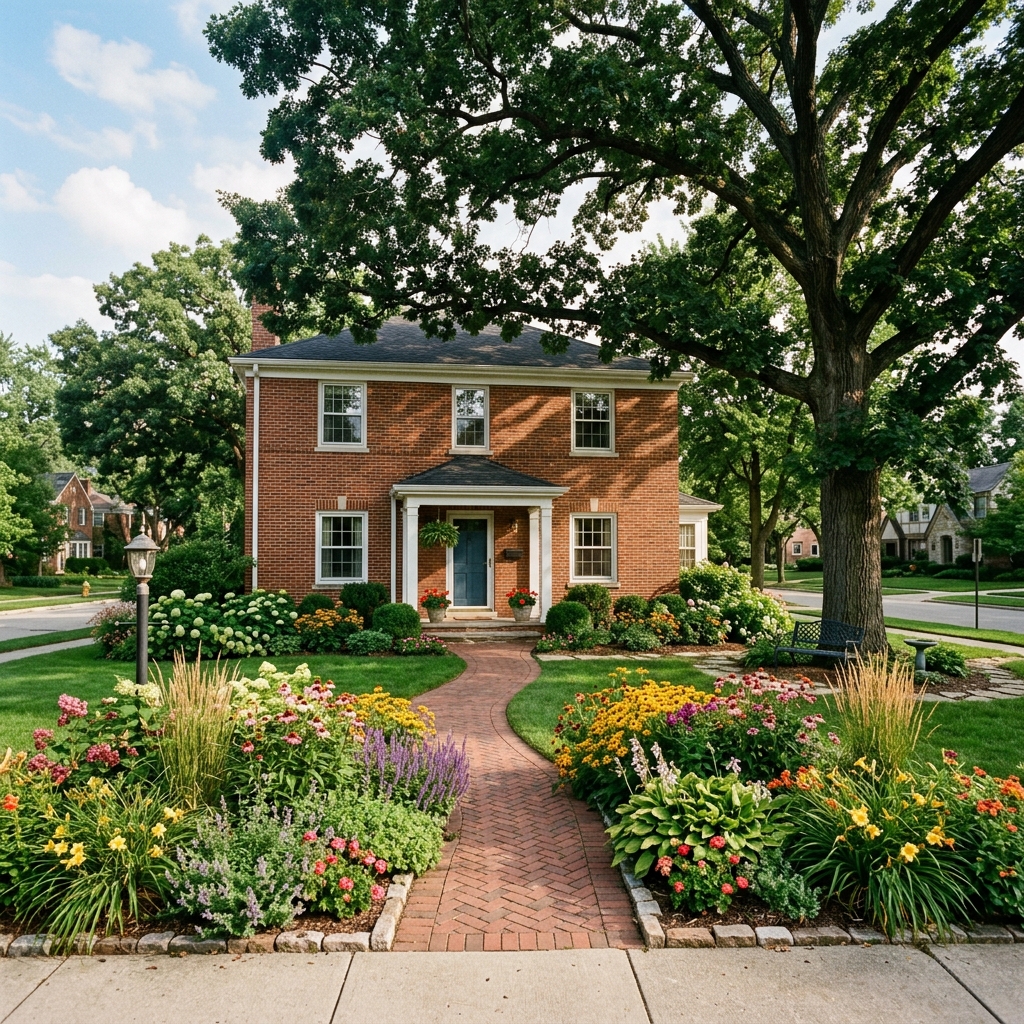
What Park Ridge Homeowners Near Maine South Should Know About Landscape Design
The first thing we tell every client around the Maine South area is that the design has to start with the canopy, not the catalog. The streets feeding off Cumberland and Dee Road sit under sixty-plus years of mature parkway oak growth. Most of these front yards are partial shade by 10 a.m. and full shade by mid-afternoon. A planting plan built around full-sun perennials looks great in the rendering and dies by the second August.
The second thing is bed-line clarity. The houses around Maine South are mostly modest in scale, and a landscape that runs amok with curving beds and mixed plant collections reads as visual noise from the sidewalk. Clean bed lines, mass plantings of three or four species, and considered repetition do more for these properties than any “more is more” garden-center approach. We work the bed lines first, the plant list second.
The third is the soil. Park Ridge sits on heavy clay that drains slowly, holds water near the surface in spring, and bakes hard in midsummer. Plant selections that work in well-amended Schaumburg new-construction soil sometimes fail in unamended Park Ridge clay. We test every site, amend where we can, and choose plants that actually want to live in clay rather than tolerate it under duress.
When we walk a property in the Maine South area, we look at all three of these factors before any plant gets named.
Why Park Ridge’s Older Housing Stock Changes the Design Conversation
Most of the homes near Maine South were built between the late 1920s and the early 1960s. The architecture is doing a lot of design work on its own. Limestone foundations, brick faces in muted tones, bay windows, original mullions, brackets, gable returns. Drop a generic suburban front yard plan onto a 1938 Tudor and it looks wrong on day one. The landscape needs to read as part of the same building rather than something delivered separately.
What that usually means is restraint on plant species. We lean toward palettes that hold structure all year, anchor the bed lines with evergreens that stay short and tight, and use perennials in fewer, bolder masses rather than ten-species mixes. The landscape language matches the architectural language. Considered, layered, restrained.
The other consideration is the original parkway tree. A lot of Maine South area properties have a forty-inch oak or maple in the parkway that’s been there for sixty years. That tree is part of the front yard composition whether the homeowner thinks of it that way or not. Designs that ignore the parkway tree sometimes plant species that compete with it for water and light, and the planting struggles. Designs that work with the parkway tree treat it as part of the canopy and choose plants that thrive in the shade it casts.
We also pay close attention to the way water runs off these older properties. Many of the houses pre-date modern grading standards, and even small drainage corrections in the design phase save a lot of trouble later.
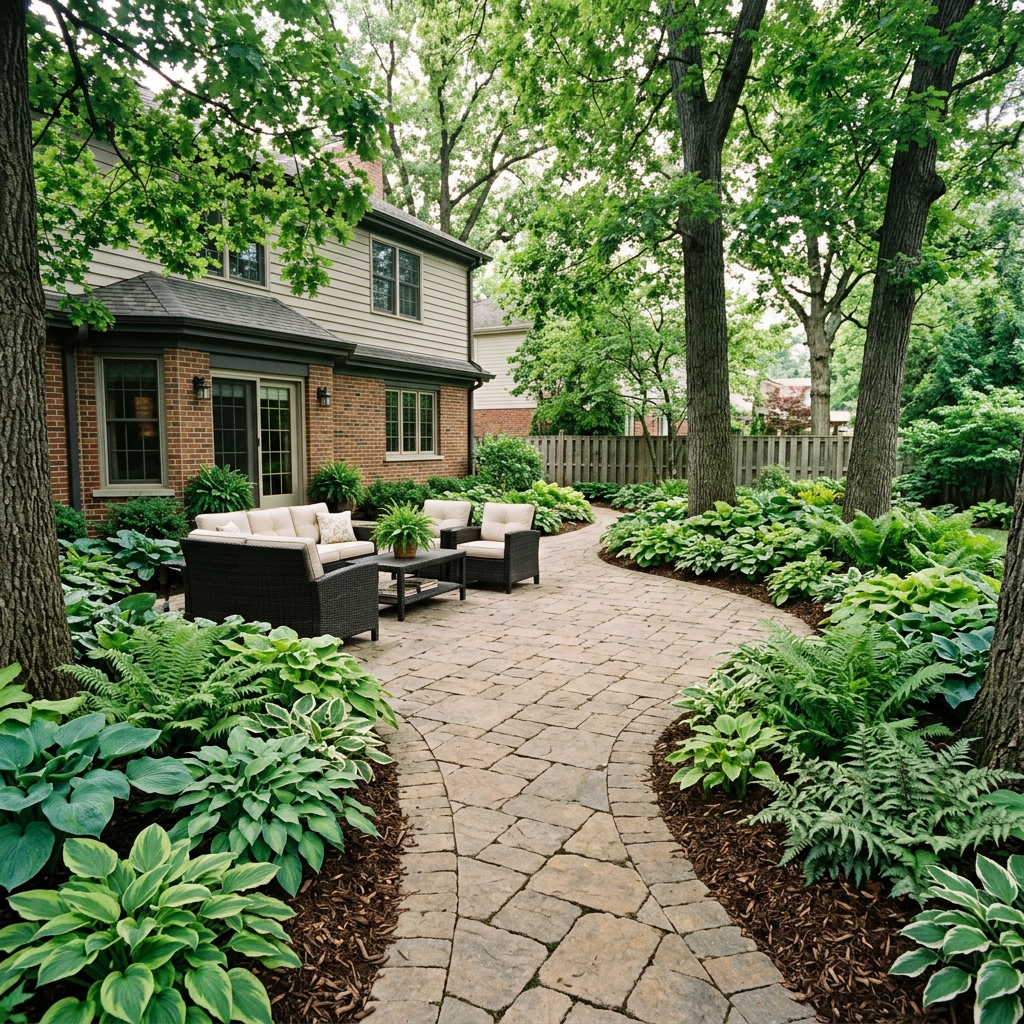
Plant Palette for the Shade Gardens Around Maine South
The plant list for a typical Maine South area front yard runs through a fairly specific set. Hostas in the larger forms, especially for anchor mass plantings under mature canopy. Hellebores for late-winter bloom and evergreen leaf structure. Astilbes for early summer bloom in deeper shade. Heucheras for color variation and texture. Native ferns for vertical layered movement. Smaller flowering shrubs like Hydrangea arborescens or Hydrangea quercifolia for mid-summer interest in dappled-shade pockets.
We avoid the mistakes that come up over and over in this neighborhood. Putting full-sun perennials in a bed that gets two hours of morning sun and calling it sun-tolerant. Specifying boxwood in deeper shade where it stretches and thins. Planting hydrangeas in dry shade against a foundation where they desiccate by August. Each of those failures is preventable if the design starts with a real measurement of the actual light pattern.
Mass planting matters more on these properties than mixed perennial collections. A bed of fifteen of the same hosta variety reads beautiful from the sidewalk. Fifteen different perennial species in the same bed reads chaotic. The architecture in the Maine South area is restrained enough that the landscape needs to follow suit.
We also include at least one piece of evergreen anchor structure on every front yard design here. Without it, the whole composition disappears in November and stays gone until April. With it, the property reads as a designed landscape across all twelve months.
Drainage and Grading Around Older Maine South Properties
The houses around Maine South pre-date a lot of the modern grading practices that come standard on newer-construction sites. Foundation drainage was minimal. Rain leaders often dumped water within a foot of the house wall. Original lawn grades sometimes pitched the wrong way and have been getting worse for decades as soil settles. A landscape design that ignores those underlying drainage realities can fail in expensive ways even if the planting plan is excellent.
We start every Maine South area design with a careful look at where water actually moves on the property. Where the rain leaders discharge. Whether the lawn pitches toward the house or away from it. Whether there are persistent wet spots that show up after every storm. Whether a neighbor’s grade is sending water across the property line. None of those issues show up on a plan drawing. All of them have to be observed on the ground.
Once we know how the water actually moves, we either work around it with plant selection, regrade where it’s needed, install a French drain or dry well to handle a chronic problem, or extend rain leaders out to a useful discharge point in the yard. The planting plan follows the drainage plan, not the other way around.
The other older-home reality is buried debris. Every property eventually surprises us with old construction debris, abandoned utility lines, or compacted fill from a long-ago renovation. We allow for it in the schedule and the budget so it doesn’t surprise the homeowner.
Starting a Design Conversation in the Maine South Area
Most Maine South area design projects start with a phone call or an email and a site visit a week or two later. The site visit is unrushed. We walk the property, look at the architecture, sit on the front porch if there is one, ask about how the family uses the yard now, and ask about how they want to use it differently. Vilma takes notes, takes photos, and measures key dimensions on the way out.
The next step is a hand sketch and a conversation about budget. We don’t deliver a polished rendering until both sides agree on the design direction. That keeps the design honest and the revisions inexpensive. Once the direction is locked, we move to a refined plan, plant selection, and a project schedule.
Installation in this neighborhood usually runs a one-to-three-week window depending on hardscape scope. Front-yard-only projects often finish in a working week. Backyard work with patio replacement or significant grading runs longer. We’re realistic about timing and we tell clients what to expect rather than padding a window we hope to beat.
The Maine South area is part of our regular weekly territory and we know the streets, the soils, and the tree lines well. If you want the bigger picture of where we work across the region, you can check availability across our coverage area.
Frequently Asked Questions About Landscape Design Near Maine South
Do you cover the Maine South side of Park Ridge?
That whole area, yep. South Park, the streets running off Cumberland and Dee Road, the blocks between Maine South and Devon. Vilma is in those streets most weeks during design season. Drop your nearest cross street when you call and we will give you something real instead of a generic two-week window.
How long until Vilma can come look at the property?
Spring runs the longest queue. We are typically two or three weeks out for a first site visit between February and May. Late summer and fall, you can usually see Vilma inside a week. Tell us if there is a deadline behind the project so we can plan against it instead of guessing.
The house was built in 1948. Does that change the design?
A lot, actually. Older Park Ridge homes carry architectural detail that the landscape needs to read against, original drainage patterns from before modern grading practice, and a parkway tree pattern older than the house. Those are the inputs we work from on every Maine South area project rather than starting with a generic plan and adapting it.
Will the heavy Park Ridge clay limit my plant options?
It changes which plants thrive long term, but our design palette is built around plants that actually want clay. Hellebores, hostas, ornamental alliums, switchgrass, native woodland understory plants. They perform on clay rather than tolerate it, which means the landscape still looks the way it should five summers in.
Do I need a Park Ridge permit for the work?
Depends on what we are doing. Larger paver patios, retaining walls past a certain height, drainage that affects a neighbor's lot, and some tree removal cases all need permits. Anything our scope triggers, we file and inspect through ourselves. Homeowners on this side of Park Ridge usually never see the paperwork.
Schedule a design consultation with Amliv Land Designs at (847) 485-9619 or email amlivlanddesigns@gmail.com. Vilma works with homeowners across Des Plaines and the northern Chicago suburbs on residential landscape design, installation, drainage, and outdoor lighting. The EPA notes that thoughtful landscape design can reduce outdoor water use by half, which is part of why plant selection matters.