
Outdoor Kitchen Design in Des Plaines, IL
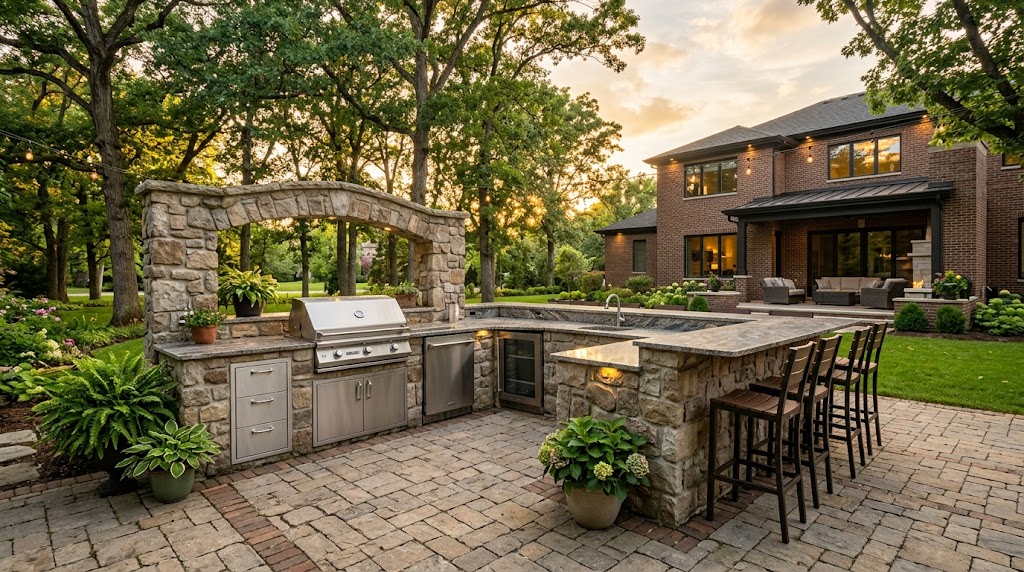
Outdoor kitchen design in Des Plaines is the planning step that decides whether your finished kitchen actually works for the way you cook outside, or sits gorgeous and unused after the first summer. Layout, gas line routing, grill brand and venting, counter space, refrigerator placement, drainage, and Chicago-winter durability all get decided in the design phase before any concrete gets poured.
TLDR
- Outdoor kitchen design is the layout, appliance specification, and utility-routing plan we draw before construction starts.
- Plans coordinate the kitchen with the patio, gas line, water line, and electrical from day one.
- Chicago freeze-thaw decides the materials choice. Stainless, granite, and stone facade survive; cheaper veneer does not.
- We design for the cook who actually uses the space, not for staged photos.
- Built-in vs freestanding grill, natural gas vs propane, ventilation hood, drainage, and winterization all get specified up front.
We are Amliv Land Designs. Family-run, twenty-plus years designing outdoor kitchens across Cook and DuPage Counties. Our plans treat the outdoor kitchen the way an architect treats an indoor one. Work triangle for the cook. Counter clearance for prep. Smoke routing away from seating. Drainage so the granite does not pool standing water through a Chicago thaw cycle.
Below: how the design phase actually works on our outdoor kitchen projects, the failure modes we see when designs get skipped or shortcut, what works in Chicago weather and what does not, and honest answers to the questions homeowners ask most before committing to an outdoor kitchen build.
Most outdoor kitchen projects we design end up coordinating with the rest of the backyard. The patio that supports the kitchen is part of the structural build phase, and the lighting that makes the kitchen usable after sunset gets specified separately as a layered photometric plan. If the project is bigger than just the kitchen, the broader outdoor room layout decides where it sits.
What an Outdoor Kitchen Design Phase Actually Covers
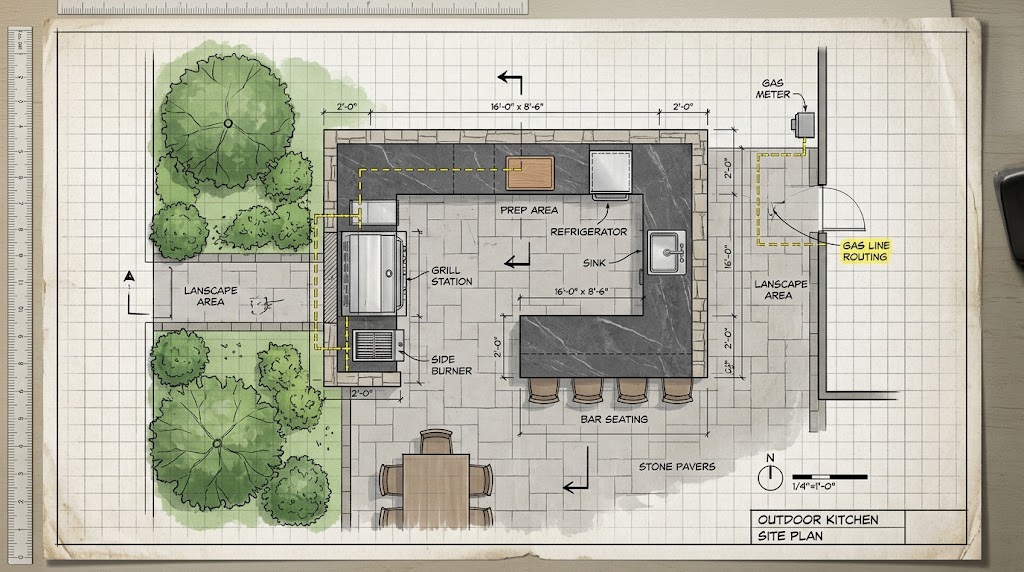
Every outdoor kitchen plan we deliver runs the same sequence: site walk during the day to catalog where the existing patio sits and how it relates to the house; client conversation about how the family actually cooks outside (grill only, or full prep with sink and fridge); layout drafted to scale with the work triangle (cook, prep, cold) sized to real bodies and real platters; appliance specification with brand, model, dimensions, ventilation requirements, and gas or electric needs; utility routing schematic showing gas line path, water line if a sink is in scope, electrical for the refrigerator and ventilation hood, drainage routing so the counter sheds water during a thaw; material specification for facade, counter, ventilation hood, and protective covers; coordination with whatever else is going into the yard so trenches do not conflict. The plan is what gets built. The build crew works to the plan.
What 20 Years of Outdoor Kitchen Design Taught Us
Twenty years of running outdoor kitchen design across Cook and DuPage Counties teaches you the failure modes that do not show up in shelter magazine photos.
First mistake we see: kitchen too far from the back door. Owner wants the kitchen at the back corner of the yard with the view. Six months in, nobody walks a hundred feet to grab a beer or replenish ice. The kitchen gets used twice a summer. Outdoor kitchens that get used live within fifteen feet of the back door.
Second mistake: ignoring the prevailing wind. Grill smoke blows directly at the seating zone every time the wind comes off the south. We watch the wind during the site walk before we site the grill, because nobody wants to eat dinner inside a smoke cloud.
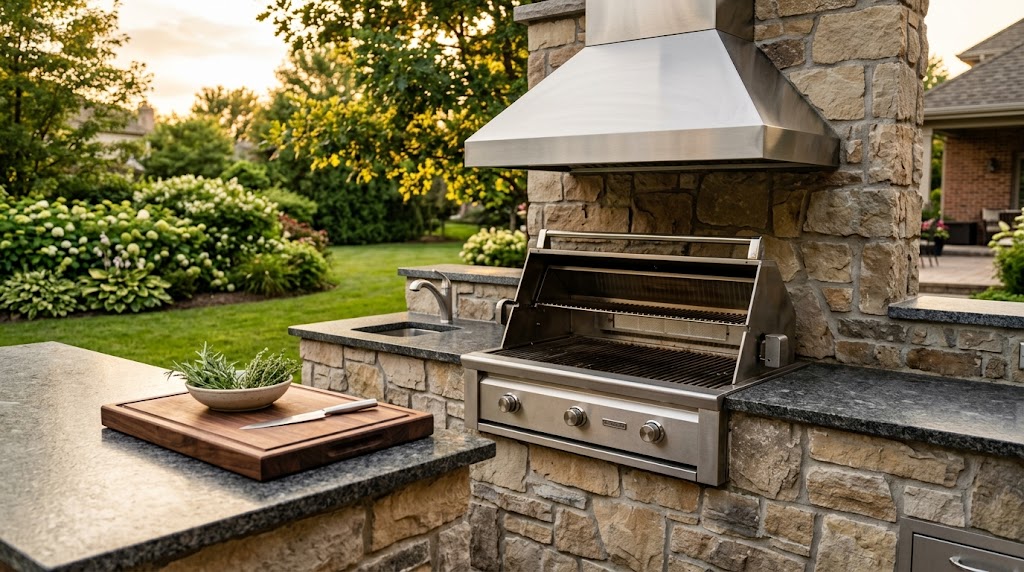
Third mistake: cheap stone veneer applied over an outdoor kitchen frame. Looks great on day one. Two Chicago winters later the veneer has popped, cracked, or fallen off because the freeze-thaw cycle behind it pushed the bond apart. We use real stone, dimensional granite, and stainless cladding because those survive twenty winters.
Fourth mistake: no ventilation hood over a built-in grill, on the assumption that outdoor airflow handles smoke. Tucked under a pergola or against a house wall, that smoke has nowhere to go and stains everything overhead. A hood vented up and out is part of the design when the grill sits in any partially enclosed location.
Fifth mistake: gas and water line routing left to the build crew to figure out. Lines end up taking the longest path around something that should have been planned around. Plans we draw show every utility run with a measured path so the trenching is right the first time.
What Chicago Weather Does to an Outdoor Kitchen
Chicago weather puts an outdoor kitchen through cycles that a kitchen in San Diego never sees. Plans that ignore that reality fail by year five.
Freeze-thaw is the big one. Water that pools on a counter in October freezes in December, expands, finds the smallest crack in the sealer, and pries the joint apart. By April that crack is a quarter inch wide and the granite is migrating. Our designs slope counters a quarter inch per linear foot for surface drainage, and we spec sealers rated for Midwest freeze-thaw cycles.
Humidity is the second one. Summer humidity off Lake Michigan corrodes stainless steel that was never marine-grade. Cabinet hardware rusts. Fastener heads bleed. We spec 304 or 316 stainless for any component that lives outside year-round, and we tell homeowners to expect to wipe everything down at season transitions whether they think it needs it or not.
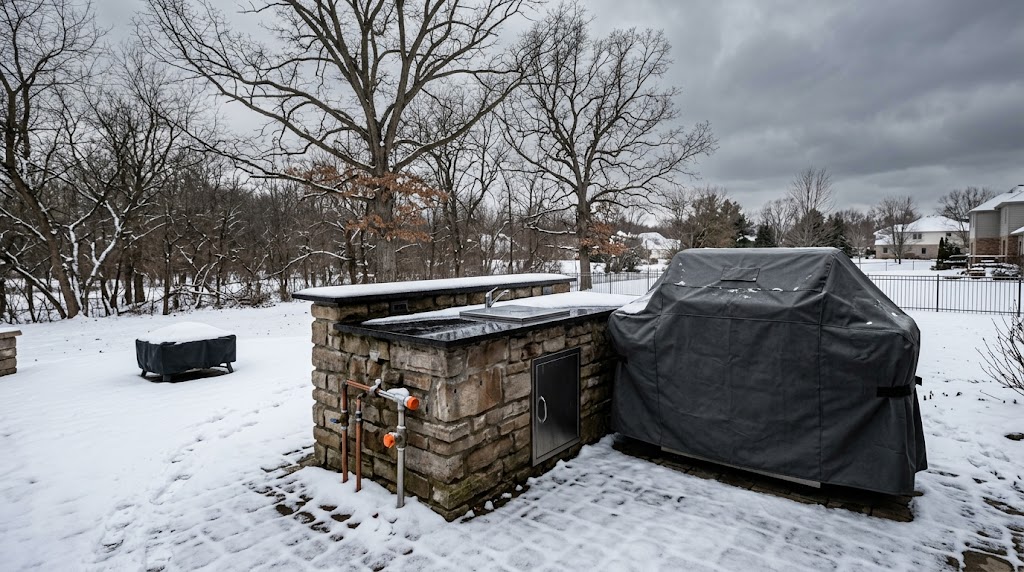
Winterization is the third. Sink water lines drain in October, propane lines disconnect, the grill gets a cover, the refrigerator either comes inside or stays plugged in with a winter setting. Plans we draw include a winterization checklist as a deliverable, because the people doing the build are not the people doing the winter shutdown.
Plans built without these three considerations photograph well in May and start failing in February. Plans built with them survive the way real Chicago outdoor kitchens are supposed to.
For broader context on outdoor kitchen safety and ventilation, the National Fire Protection Association cooking-safety guidance covers the same clearance and ventilation principles we apply when siting a built-in grill.
Frequently Asked Questions
What Does an Outdoor Kitchen Design Phase Actually Cover?
The design phase covers layout, appliance specification, gas and water line routing, electrical, ventilation, drainage, and material selection drawn to scale before any construction starts. The plan becomes the build document the contractor follows, so there is no guessing onsite.
Can I Add an Outdoor Kitchen to My Existing Patio?
Often yes, depending on the patio's structural depth and whether utility routing can reach the planned location. We assess the existing patio during the site walk and tell you whether overlay works or whether a section needs to come up to run gas, water, or electrical.
Do I Need a Permit for an Outdoor Kitchen Build in Des Plaines?
Yes, when natural gas, water, or electrical work is part of the build. Permit submission gets handled as part of our design phase so the inspector schedule does not push back the build start. Smaller propane-only setups sometimes skip the permit, and we tell you which category your specific project falls into.
What Drives the Cost of an Outdoor Kitchen Project?
Four things, in order: appliance package (built-in grill, refrigerator, sink, ventilation), utility routing distance from the house, counter material (stainless versus granite versus dimensional stone), and structural facade. Pricing gets discussed during the consultation since the right package depends on how the family actually cooks outside.
Should I Run Natural Gas or Use Propane for an Outdoor Kitchen?
Natural gas if the house has it and the line can reach the kitchen footprint without major trenching. No tank to swap, no running out at the wrong moment. Propane if natural gas is not at the property or if the kitchen sits too far from the existing line to make trenching worthwhile.
What Materials Hold Up Best in Chicago Outdoor Kitchens?
Stainless steel rated 304 or 316 for any component exposed year-round, dimensional granite or quartzite for counters, real stone or full-thickness brick for facade, and copper or stainless flashing at every horizontal-to-vertical transition. Cheap stone veneer, painted finishes, and consumer-grade hardware are the three things we won't spec on a Chicago kitchen.
Ready To Get Started?
Looking for outdoor kitchen design in Des Plaines? Schedule with Amliv Land Designs. Family-run, twenty-plus years across Cook and DuPage Counties. Call us at (847) 485-9619 to get your outdoor kitchen project started today!